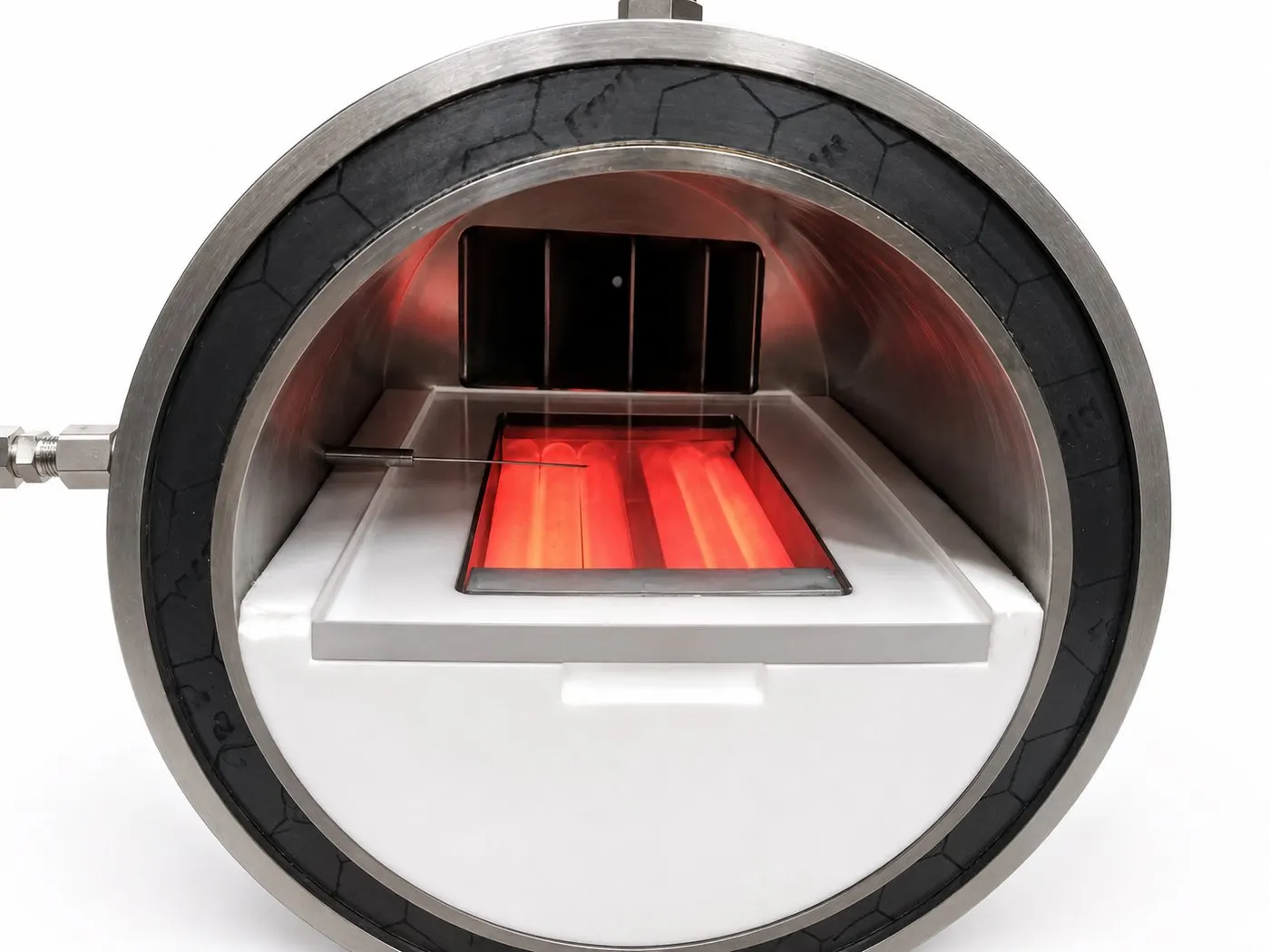
IR-Reactor
Cold-wall radiative heating for selective surface reactions
In high-temperature gas-phase synthesis and chemical vapor deposition (CVD), conventional hot-wall furnaces heat the entire vessel volume, which often leads to parasitic wall deposition, precursor degradation in the gas phase, and sluggish thermal response times. To overcome these challenges, InVerTec designs and constructs custom-engineered infrared (IR) reactors based on targeted radiative energy transfer and cold-wall chamber architectures.
By utilizing high-performance infrared emitters coupled with precision optical reflectors, thermal radiation is focused directly onto the sample or substrate while maintaining actively cooled or ambient-temperature vessel walls. This configuration minimizes parasitic side reactions, enables exceptionally fast heating rates, and allows dynamic thermal cycling under tightly controlled atmospheric and vacuum conditions.
Key capabilities
- Selective radiative substrate heating in a cold-wall reactor environment
- High-transmission, thermal-shock-resistant quartz reaction vessels
- Custom parabolic and elliptical optical reflector geometries
- Active water- or gas-cooled reactor shells and flange assemblies
- High-speed optical pyrometry and dynamic PID/thyristor power control
- Automated dosing and safety interlocks for pyrophoric and toxic gases
Technical Focus
- Tailored Quartz Chamber Design: High-transmission, thermal-shock-resistant quartz reactor vessels engineered for optimized optical transparency and chemical durability.
- Precision Optical Reflector Geometries: Custom-engineered parabolic and elliptical reflector assemblies (e.g., gold-coated or polished aluminum) optimized via optical modeling to achieve uniform radiative flux across the reaction zone.
- Cold-Wall & Active Cooling Systems: Water-cooled or gas-cooled reactor shells and flange connections that prevent thermal degradation of peripheral seals and eliminate parasitic deposition on chamber walls.
- Non-Contact Thermal Monitoring & Control: High-speed pyrometry and shielded thermocouple arrays integrated with dynamic power controllers (PID/thyristor units) for immediate, reproducible thermal profile regulation.
- Hazardous & Pyrophoric Gas Integration: Automated multi-channel gas dosing systems, vacuum manifold assemblies, and dedicated safety interlocks engineered for safe operation with toxic, flammable, or pyrophoric precursors.
Application Highlight: Multilayer Si/C Synthesis for Next-Generation Batteries
A prime showcase of InVerTec’s reactor design expertise is a bespoke IR-heated reactor platform developed for the synthesis of advanced energy storage materials. Next-generation lithium-ion and solid-state batteries require alternating silicon and carbon (Si/C) multilayer nano-architectures to boost electrochemical capacity while accommodating mechanical stress.
The Engineering Challenge: The deposition process relies on monosilane and acetylene as gaseous precursors. Monosilane is pyrophoric and ignites spontaneously in contact with air, while the synthesized active battery materials degrade rapidly upon exposure to trace oxygen or moisture. The system demanded precise substrate heating without premature precursor decomposition, combined with an absolute guarantee of oxygen-free handling throughout the entire synthesis and extraction process.
The InVerTec Solution: InVerTec engineered a specialized, hermetically sealed IR quartz reactor coupled with a dedicated transfer-lock mechanism:
- Selective Surface Reaction: IR radiation heats exclusively the target substrate in a cold-wall envelope, confining thermal cracking to the surface boundary layer and producing uniform, alternating Si/C nanolayers.
- Hermetic Transfer-Lock Concept: Following deposition, the reactor chamber can be detached as a self-contained, hermetically sealed unit without interrupting the protective gas atmosphere.
- Direct Glovebox Docking: The sealed unit is transferred into an inert-atmosphere glovebox workstation where the samples are safely retrieved and prepared for post-processing with zero ambient exposure.
This integrated platform combines rapid radiative thermal control, uncompromising process safety for pyrophoric gases, and continuous contamination-free sample logistics.