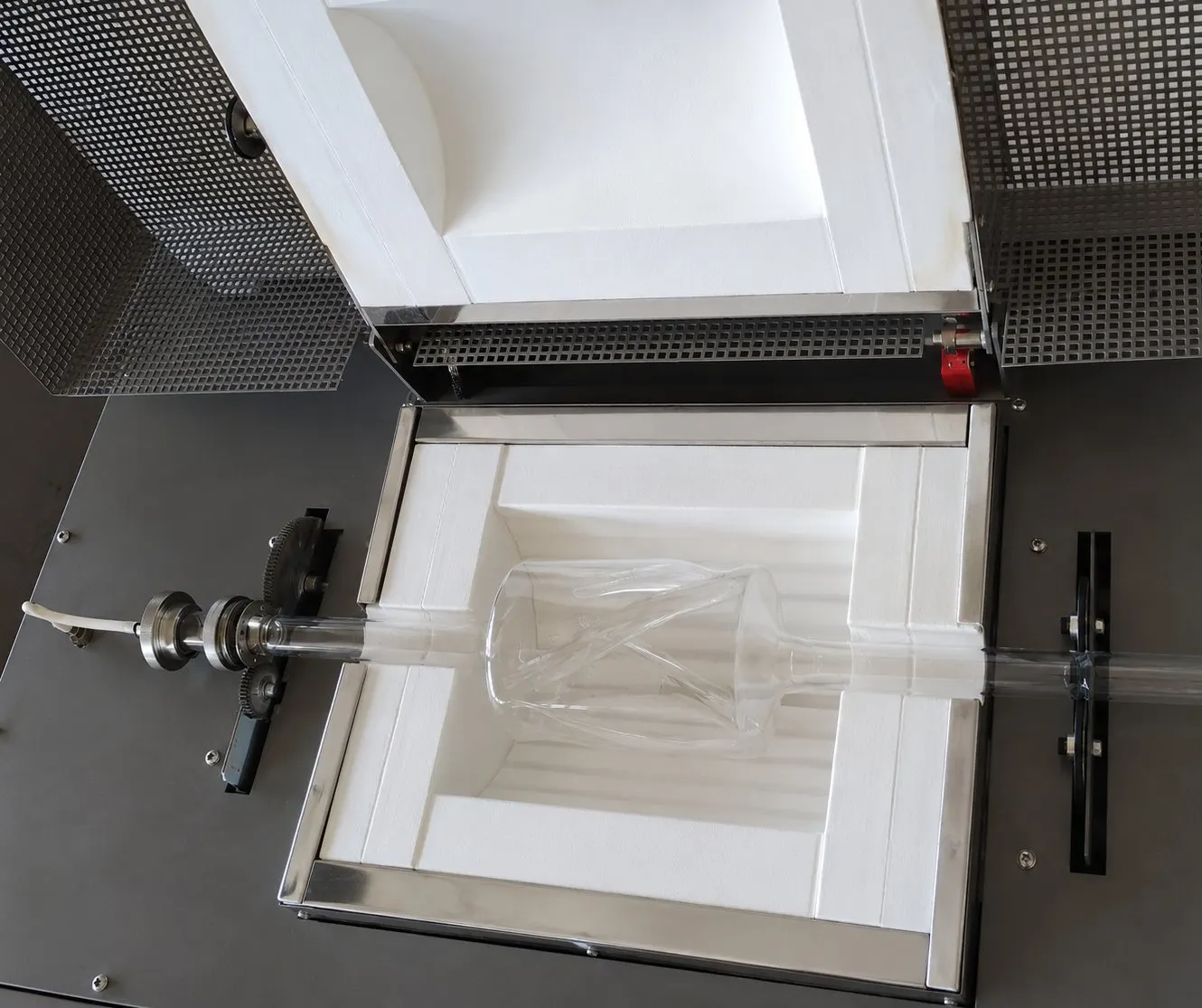
Rotary Kiln Reactors
Continuous thermal treatment of free-flowing particulate solids
Rotary kiln reactors are continuous thermal processing platforms engineered for the uniform thermal treatment, calcination, and chemical conversion of free-flowing particulate solids, powders, and granulates. By combining gentle rotational tumbling with gravity-assisted axial transport, rotary kilns provide homogeneous solid-phase mixing, defined residence time distributions, and consistent product quality without particle agglomeration.
Key capabilities
- Controlled axial solids transport and adjustable bed residence time
- Radial bed mixing and superior thermal uniformity without hotspots
- Gas-tight operation under inert, reducing, or oxidative atmospheres
- Multi-zone electric heating for customizable longitudinal temperature profiles
- Integrated solids dosing, cyclone separation, and off-gas condensation
- Experimental scale-up parameter optimization and balance validation
Technical Focus
The core of the rotary kiln system is an inclined cylindrical vessel that rotates continuously around its longitudinal axis:
- Controlled Axial Transport: A slight tilt relative to the horizontal plane, combined with adjustable rotational speeds, precisely regulates material throughput and bed residence time from feed to discharge.
- Radial Mixing & Thermal Uniformity: Continuous overturning (tumbling) of the material bed exposes fresh solid surfaces to the heated reactor wall and internal gas phase, eliminating localized hotspots and ensuring superior radial temperature homogeneity.
- Controlled Reaction Atmosphere: Reactors can be operated under inert, reducing, or oxidative atmospheres, utilizing gas-tight dynamic rotary seals to prevent atmospheric contamination or fugitive emissions.
- Key Applications & Research Focus: Deployed across continuous pyrolysis and polymer recycling (shredded plastics, polymer blends, and organic residues), thermal desorption (volatilization of organic fractions from inorganic matrices), and calcination and high-temperature treatment (specialty powders, inorganic minerals, catalysts, and ceramic precursors).
Achievements
- Multi-Zone Electric Heating: Equipped with independently controlled external heating zones, enabling customizable longitudinal temperature profiles along the reaction path.
- Integrated Peripheral Systems: Coupled with continuous precision solids dosing, gas-tight locks, downstream cyclone separation, and multi-stage off-gas condensation trains.
- Scale-Up Parameter Optimization: Experimental validation covering bed fill levels, residence time modeling, thermal kinetics, and full mass and energy balance evaluations to de-risk industrial plant implementation.