Quenching Systems
Rapid thermal stabilization of non-equilibrium product streams
In high-temperature thermal conversion, gas-phase synthesis, and catalytic cracking, process streams exiting the primary reaction zone frequently exist in a dynamic, non-equilibrium state. Without immediate and controlled cooling, valuable reaction intermediates rapidly degrade through unwanted secondary cracking, recombination, or yield-reducing side reactions.
To stabilize targeted product distributions and recover sensitive particulate matter, InVerTec designs, fabricates, and operates modular continuous quenching systems tailored to the severe thermal demands of high-temperature processes.
Key capabilities
- Rapid thermal quenching to “freeze in” non-equilibrium product distributions
- Selective gas scrubbing and chemisorption using aqueous or organic media
- High-velocity droplet atomization and jet scrubbing for cohesive particulates
- In-vessel multiphase separation via flotation or sedimentation
- Continuous closed-loop operation up to 80 °C (aqueous media) at atmospheric pressure
- Skid-mounted architecture flange-mounted directly to high-temperature reactors
1. Gas Quenching (Kinetic “Freeze-In” & Chemisorption)
Engineered for processes where rapid temperature reduction is essential to preserve reaction selectivity and product integrity:
- Kinetic Stabilization: Instantly cools the hot gas stream to “freeze in” non-equilibrium product compositions, suppressing thermodynamic recombination into lower-value byproducts.
- Chemisorption & Gas Scrubbing: Employs either aqueous or organic quenching fluids capable of selectively absorbing and neutralizing targeted gaseous compounds or acid gases directly from the effluent stream.
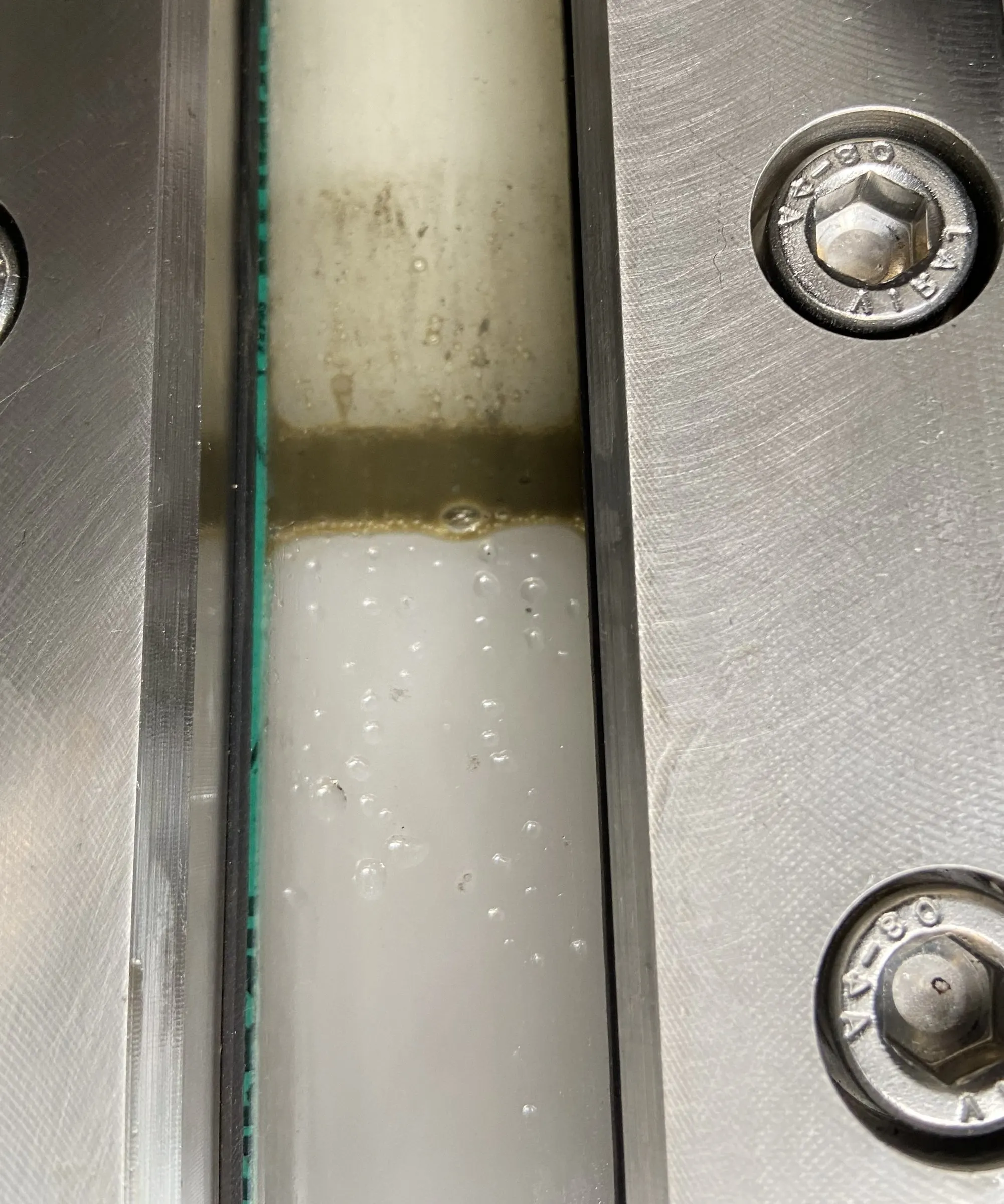
- In-Vessel Phase Separation: The quench vessel design supports in-situ multiphase separation, allowing immediate sedimentation or flotation of condensed liquids and insoluble reaction products.
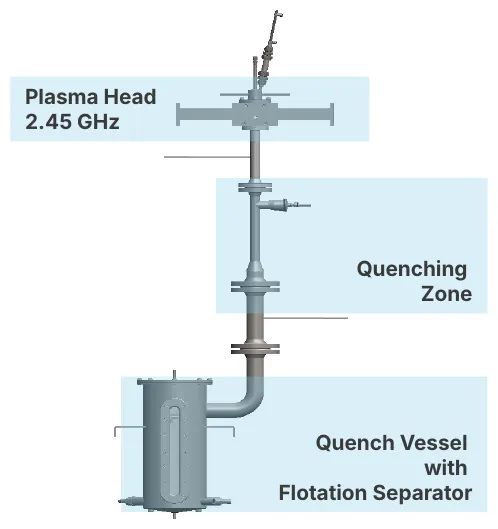
2. Particle Quenching & Wet Scrubbing
Engineered for gas streams laden with reactive, cohesive, or high-temperature particulates where dry filtration systems (such as hot-gas filters) are prone to clogging, sintering, or particle agglomeration:
- Droplet Collision & Jet Scrubbing: High-velocity droplet atomizers and integrated jet scrubbers inject fine liquid droplets into the gas stream. Suspended particulates adhere to the droplet surfaces and are continuously carried into the collection sump.
- Slurry Recovery: Separated solids can be recovered downstream via continuous sedimentation, flotation, or wet-filtration units.
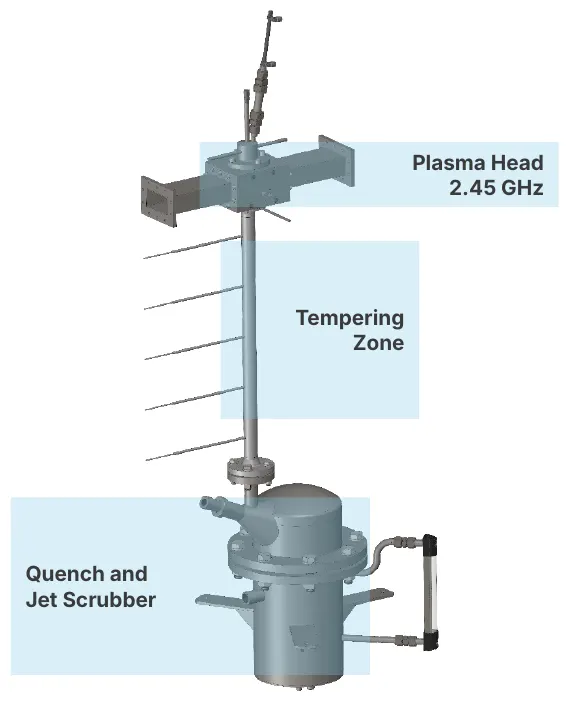
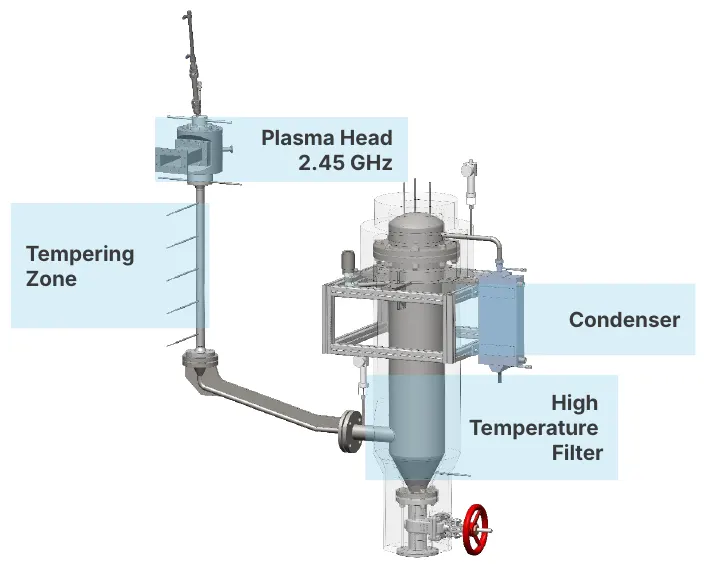
Achievements
All quenching systems are custom-engineered, skid-mounted, and designed for direct mechanical integration with laboratory-, pilot-, and industrial-scale reactors:
- Continuous Closed-Loop Operation: Fully continuous atmospheric operation with closed-loop liquid recirculation and maximum liquid quench temperatures up to 80 °C for aqueous media.
- Versatile Quenching Media: Compatible with aqueous solutions, acidic or basic scrubbing fluids, and selective organic solvents.
- Integrated Separation & Reactor Coupling: Equipped with flotation chambers, sedimentation cones, and fine-mist jet scrubbers, flange-mounted directly to high-temperature reactors, tubular systems, or thermal conversion units.